

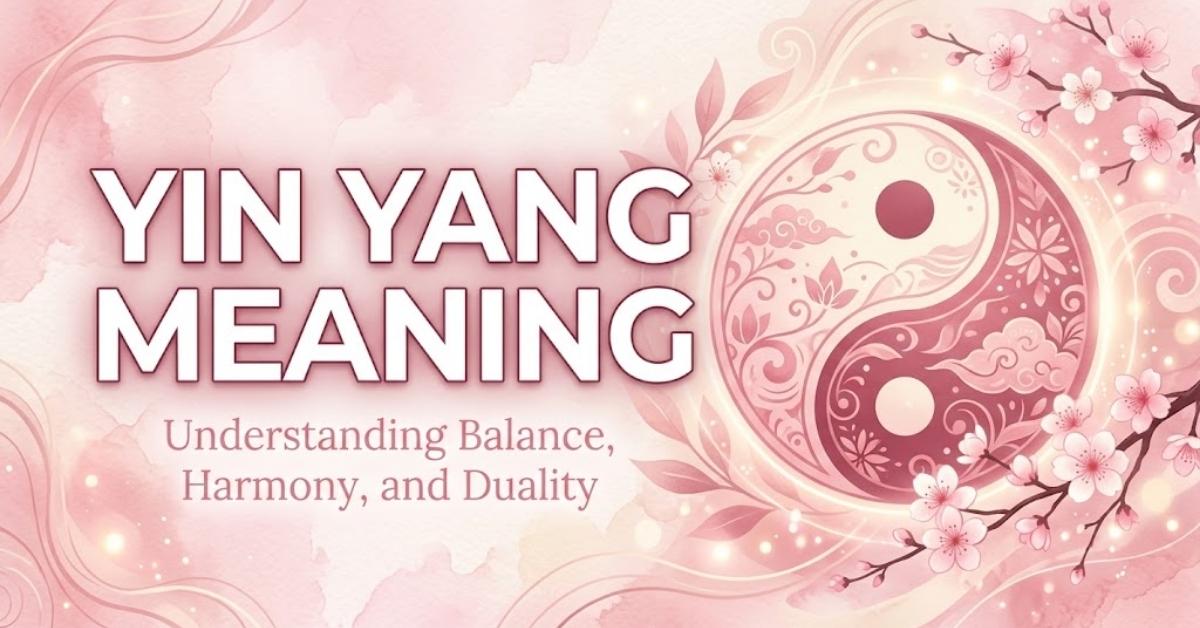
The yin and yang symbol is a famous design from Chinese philosophy. It shows two connected sides, one black and one white. Each side represents different qualities that work together. Yin is often linked with darkness, stillness, and rest. Yang represents light, movement, and activity. Neither side is completely good or bad. Instead, both depend on each other to create harmony. The small dot inside each side shows that every opposite contains a part of the other.
The yin yang meaning goes beyond a simple black-and-white design. It teaches us that life needs balance and change. For example, working hard is important, but taking time to rest matters too. The symbol also helps explain how different personalities can complement each other. Today, people use it in jewelry, tattoos, artwork, and social media. Understanding its roots helps you appreciate its deeper message about harmony, connection, and balance in everyday life.
What Does the Yin and Yang Symbol Mean? – Quick Meaning
The yin and yang symbol represents balance, harmony, and the connection between opposing forces. It comes from Chinese philosophy and shows how different qualities can work together. The black side represents yin, often linked with darkness, stillness, and the moon. The white side represents yang, associated with light, activity, and the sun. Neither side is completely good or bad. Instead, each depends on the other to create a whole.
The small dot inside each side shows that every quality contains a trace of its opposite. This idea applies to everyday life, too.
- Yin: Stillness, rest, coolness, and reflection.
- Yang: Activity, warmth, movement, and energy.
- Main lesson: Balance comes from understanding differences, not eliminating them.
For example, working hard matters, but rest helps you recover. Together, they support a healthier routine.
Origin and Background
The yin and yang symbol has deep roots in ancient Chinese thought. It connects closely with Taoism, also called Daoism, and the broader Chinese philosophical tradition. Yin and yang describe complementary qualities that interact and change over time. Rather than treating the world as a battle between good and evil, this philosophy emphasizes relationships, transformation, and balance. The familiar circular symbol, known as the taijitu, visually expresses this relationship. Its curved dividing line suggests movement rather than a fixed boundary.
Over centuries, yin and yang influenced Chinese medicine, martial arts, art, and traditional ideas about nature. Today, people also use the symbol in jewelry, tattoos, home decor, and online discussions.
- Historical roots: Ancient Chinese philosophy.
- Key idea: Opposing qualities depend on each other.
- Modern use: A symbol of harmony, personal growth, and interconnectedness.
Cultural Influence
Yin and yang has influenced many areas of Chinese culture, including traditional medicine, landscape design, martial arts, and philosophical writing. People often use its principles to discuss how rest and activity, warmth and coolness, or stillness and movement relate to one another. However, these applications vary across traditions. The symbol also appears in modern fashion, tattoos, and social media because its circular design makes a complex idea easy to recognize.
Consider a person who spends the entire week working. They may need quiet time to restore their energy. This example reflects the relationship between activity and rest without suggesting that life must always remain perfectly balanced.
- Philosophy: Explains relationships between complementary forces.
- Traditional practices: Influences several Chinese cultural traditions.
- Modern culture: Appears in artwork, accessories, and digital content.
Real-Life Conversations

People often discuss yin and yang when talking about relationships, personality differences, or finding balance in life. The symbol gives them a simple way to describe how different qualities can complement each other. For example, one friend might enjoy planning while another prefers spontaneity. Their differences can become strengths when they communicate and cooperate. However, yin and yang should not become an excuse for controlling behavior or ignoring personal boundaries.
These everyday conversations show how the symbol can communicate a broader idea without requiring a lengthy philosophical explanation.
- Friends may use it to describe different personalities.
- Couples may use it to discuss complementary habits.
- Social media users may share it to represent harmony or personal growth.
WhatsApp Chat
Friend A: I love planning everything before the weekend.
Friend B: And I prefer deciding things at the last minute.
Friend A: We’re basically yin and yang!
Friend B: True. You organize everything, and I keep things spontaneous.
This conversation uses the symbol playfully. The friends have different habits, but those differences can help them enjoy their time together.
Instagram DM
Person A: Your room looks so peaceful, but mine is full of colorful decorations.
Person B: Different styles, same love for our spaces.
Person A: Yin and yang energy!
Person B: Exactly. Both can feel like home.
Here, the symbol describes two contrasting styles that both express personal taste. Neither style needs to be better than the other.
TikTok Comments
Creator: My morning routine is meditation, while my best friend’s routine is an intense workout.
Commenter 1: The ultimate yin and yang duo.
Commenter 2: One brings calm, and the other brings energy!
This example shows how social media users apply yin and yang to contrasting routines. The comparison is lighthearted and easy to understand.
Text Message
Person A: I want a quiet night at home.
Person B: I was hoping we could go out dancing.
Person A: Our plans are complete opposites.
Person B: Maybe we can have dinner first and go dancing another night.
This exchange demonstrates a practical kind of balance. Both people express their preferences and look for a solution that respects their needs.
Emotional and Psychological Meaning
The yin and yang symbol can offer a useful way to think about emotions and personal habits. People sometimes feel confident one day and uncertain the next. They may enjoy social activities while also needing time alone. These experiences aren’t necessarily contradictions. They can reflect different needs that change with circumstances. Yin and yang provides a metaphor for accepting this complexity instead of expecting yourself to feel the same way every day.
However, the symbol isn’t a psychological diagnosis or a substitute for professional guidance. Its value lies in encouraging reflection and helping people consider different sides of an experience.
- Self-awareness: Notice when you need activity or rest.
- Emotional balance: Make room for different feelings.
- Personal growth: Recognize that your needs can change.
A Personal-Style Scenario
Imagine a student preparing for an important exam. They spend several hours reviewing notes and completing practice questions. Eventually, they feel tired and struggle to concentrate. Instead of pushing through the entire evening, they take a break, eat dinner, and return to studying later.
This situation illustrates how effort and recovery can support each other. The student doesn’t abandon responsibility by resting. They simply recognize that concentration has limits.
Yin and yang can help explain this relationship in a memorable way.
- Yang: Focused study and active effort.
- Yin: Rest, quiet reflection, and recovery.
- Practical lesson: Both effort and downtime can serve a purpose.
Usage in Different Contexts
People use the yin and yang symbol in many settings, from personal conversations to creative projects. Some use it to describe contrasting personalities. Others choose it because they appreciate its philosophical roots or balanced circular design. Its meaning often depends on the person sharing it and the situation in which it appears.
Still, the symbol has a cultural background worth understanding. Using it thoughtfully means recognizing that it represents more than a fashionable image. Its traditional meaning involves complementary forces, change, and interconnectedness.
- Use it to discuss differences that work together.
- Explain what the symbol means to you when sharing it.
- Avoid assuming everyone interprets it in the same way.
Social Media
On Instagram, TikTok, Pinterest, and other platforms, yin and yang often appears in artwork, profile pictures, captions, and lifestyle posts. Users may share it to express harmony, personal development, contrasting personalities, or an interest in Eastern philosophy. Some use the symbol simply because they appreciate its circular design.
For example, a creator might post a picture of a busy city beside a quiet garden. The caption could describe the contrast as yin and yang. This use highlights the difference between activity and stillness.
However, online interpretations can simplify the symbol’s traditional meaning. A short caption may capture one idea without explaining its full philosophical background.
Friends and Relationships
In friendships and romantic relationships, yin and yang often describes people with different but compatible qualities. One person might be outgoing while the other enjoys quiet evenings. One may prefer careful planning, while the other welcomes spontaneous adventures. These differences can create an interesting dynamic when both people respect each other’s preferences.
For example, a thoughtful planner might organize a trip while their spontaneous friend suggests unexpected stops. Each person contributes something useful.
Still, complementary personalities don’t automatically create a healthy relationship. Respect, trust, communication, and boundaries matter far more than matching a symbolic idea.
- Appreciate differences without expecting people to complete you.
- Discuss disagreements openly.
- Avoid using yin and yang to excuse harmful behavior.
Work and Professional Settings
Yin and yang can serve as a simple metaphor for different working styles. Some employees prefer detailed plans, while others thrive when they can adapt quickly. A team may benefit from both approaches if everyone communicates clearly and respects their responsibilities.
For example, one colleague might create a project timeline, while another finds creative solutions when unexpected problems appear. Their approaches can complement each other.
However, the symbol shouldn’t replace practical decisions about workload, accountability, or workplace fairness. A balanced team still needs clear goals and reasonable expectations.
- Planning can provide structure.
- Flexibility can help teams respond to change.
- Collaboration works best when each person’s contribution receives respect.
Casual vs. Serious Tone
In casual conversations, people often use yin and yang playfully to describe opposite personalities, clothing styles, or daily routines. A serious discussion might instead focus on the symbol’s philosophical roots and the relationship between complementary forces.
The tone depends on context. Someone posting matching black-and-white outfits may simply enjoy the visual comparison. A person studying Chinese philosophy may be referring to a much deeper idea.
Neither use automatically explains the full meaning of the symbol. If the cultural or philosophical context matters, provide a little more information rather than assuming everyone shares the same understanding.
When NOT to Use It
Although yin and yang can express balance and interconnectedness, it doesn’t fit every situation. The symbol carries philosophical and cultural meaning, so using it without context can lead to misunderstandings. It also shouldn’t become a shortcut for explaining complex personal problems.
For example, calling two people yin and yang might seem harmless when discussing their different hobbies. Using the same comparison to excuse disrespect or unequal treatment is another matter entirely.
Before using the symbol, consider what you want to communicate and whether the comparison respects the people involved.
- Understand the symbol beyond its appearance.
- Consider the context before applying it.
- Avoid using balance as an excuse to ignore real problems.
Avoid Oversimplifying It
Yin and yang is more than a symbol for two opposite things. Its traditional meaning includes how complementary qualities interact, depend on each other, and change over time. Reducing it to a simple statement such as “opposites attract” misses much of that complexity.
For example, two friends may have different personalities without representing every aspect of yin and yang. The comparison might work as a casual metaphor, but it doesn’t explain the full philosophical concept.
When discussing the symbol, recognize the difference between a modern interpretation and its traditional background.
Respect Cultural Significance
The yin and yang symbol comes from Chinese philosophical traditions and carries meaning beyond modern fashion. People may wear it as jewelry or use it in artwork because they appreciate its ideas about harmony and interconnectedness. Learning about its background helps prevent inaccurate assumptions.
Respectful use doesn’t require you to be an expert. Start by understanding its basic meaning and avoid presenting it as a universal symbol with exactly the same interpretation in every culture.
If you’re discussing its history, consult reliable sources about Chinese philosophy rather than relying only on social media captions.
Don’t Use It to Justify Unhealthy Situations
The idea of balance shouldn’t excuse controlling behavior, disrespect, or unfair treatment. People sometimes describe a difficult relationship as yin and yang because the partners have contrasting personalities. However, differences alone don’t make a relationship healthy.
For example, one person might be quiet while the other enjoys talking. They can respect each other’s communication styles. But repeated insults aren’t simply the opposite side of someone’s personality.
A symbolic comparison should never replace honest judgment about how people treat one another.
- Healthy differences allow mutual respect.
- Boundaries matter even when personalities contrast.
- Harmful behavior deserves attention, not romanticized explanations.
Common Misunderstandings
The yin and yang symbol appears simple, but its meaning often gets reduced to a few familiar phrases. People may assume that yin represents evil, yang represents goodness, or balance requires equal amounts of everything. Others treat it only as a spiritual decoration.
These interpretations overlook the central idea: yin and yang describe complementary qualities whose relationship changes with circumstances. Neither quality exists in complete isolation from the other.
Understanding these distinctions makes it easier to appreciate the symbol’s traditional background and use it accurately in modern conversations.
Myth 1: Yin Is Bad and Yang Is Good
Yin doesn’t mean evil, and yang doesn’t mean morally good. Both describe qualities that can be useful in different circumstances. Yin is commonly associated with stillness, coolness, darkness, and receptivity. Yang is associated with activity, warmth, light, and movement.
For example, darkness helps create the conditions for sleep, while daylight supports many daily activities. Neither automatically represents good or bad.
The symbol encourages people to consider relationships between qualities instead of dividing everything into moral categories.
Myth 2: Opposites Always Fight
Opposing qualities don’t necessarily conflict. Yin and yang emphasizes how differences can complement one another and form part of a larger whole. Activity and rest, for instance, may appear contradictory, yet both support a sustainable routine.
Imagine a musician who practices daily but also takes breaks to recover. Practice develops skill, while rest helps prevent exhaustion. The two activities serve different purposes.
In relationships and teamwork, differences can also encourage cooperation. The key is whether people handle those differences with respect and flexibility.
Myth 3: Balance Means Being Exactly Equal All the Time
Balance doesn’t require every part of life to remain perfectly equal. Needs change depending on your responsibilities, energy, environment, and goals. During exam week, studying may take more time. During a holiday, rest and recreation may become more important.
The yin and yang symbol represents an ongoing relationship between changing qualities, not a strict formula for dividing your time.
A useful question is whether your current routine supports your needs. Sometimes balance means doing more. At other times, it means slowing down.
Myth 4: It’s Only a Spiritual Symbol
Yin and yang has philosophical roots and connections to Taoism, but its use extends beyond personal spirituality. People also study it through Chinese intellectual history, traditional cultural practices, art, and design.
Some people appreciate the symbol for its philosophical meaning. Others enjoy its visual form or use it as a reminder of balance. These modern uses don’t erase its history, although they may focus on different aspects.
Understanding both the traditional background and modern interpretations gives you a fuller picture of its significance.
Comparison Table
The yin and yang symbol is often compared with other ideas about balance and opposing forces. However, these concepts don’t all mean exactly the same thing. Understanding their differences helps you avoid treating every symbol of harmony as interchangeable.
| Concept | Main meaning | Key difference |
|---|---|---|
| Yin and yang | Complementary qualities that interact and change | Rooted in Chinese philosophy |
| Balance | A suitable relationship between different needs | Broad concept used in many contexts |
| Harmony | Different elements working together peacefully | Emphasizes cooperation |
| Opposites attract | Differences may draw people together | Common expression, not a full philosophy |
| Duality | Two contrasting aspects or conditions | Doesn’t always imply interdependence |
| Equilibrium | A relatively stable state | Often used in scientific and technical contexts |
Key Insight
Yin and yang isn’t simply about keeping two sides equal. It emphasizes how different qualities relate to each other and change over time. Balance and harmony are related ideas, but they don’t fully capture the symbol’s philosophical background.
For example, work and rest may not receive equal time every day. What matters is how they support your needs over time.
The symbol can encourage thoughtful reflection, but it doesn’t provide a universal answer to every personal or social problem.
How to Respond When Someone Uses It
When someone mentions yin and yang, your response depends on the conversation. They might be joking about contrasting personalities, sharing a meaningful design, or discussing Chinese philosophy. You don’t need a complicated explanation every time.
A simple question can help you understand what they mean. If they’re using the symbol casually, a lighthearted reply may fit. If they’re discussing its cultural background, a thoughtful response shows interest.
- Read the situation before replying.
- Ask what the symbol means to them.
- Avoid assuming their interpretation matches yours.
Casual Replies
Casual replies work well when friends use yin and yang to describe their different habits or preferences.
Examples:
- “We’re different, but we work well together.”
- “That’s our perfect balance.”
- “One brings the energy, and the other brings the calm.”
- “Different styles, same team.”
These responses keep the conversation friendly without making the symbol seem more complicated than necessary.
Funny Replies
A playful response can fit when someone jokes about opposite personalities or contrasting routines. Keep the humor light and avoid mocking cultural traditions.
Examples:
- “You’re the planner, and I’m the plot twist.”
- “One of us brings peace, and the other brings snacks.”
- “Balance restored after we finally agreed on dinner.”
- “Two completely different settings, one friendship.”
These replies use yin and yang as a casual metaphor. They don’t claim to explain its full philosophical meaning.
Mature Replies
A thoughtful response works when someone uses the symbol to describe personal growth, changing needs, or a meaningful relationship.
Examples:
- “I like the reminder that different qualities can complement each other.”
- “Balance doesn’t always mean doing everything equally.”
- “Sometimes knowing when to slow down matters as much as working hard.”
- “Our differences can help us understand each other better.”
These replies move beyond appearance and focus on the ideas behind the symbol.
Respectful Replies
If someone discusses yin and yang as part of their cultural or philosophical interests, respond with curiosity rather than making assumptions.
Examples:
- “I’d like to learn more about its traditional meaning.”
- “How do you personally interpret the symbol?”
- “I didn’t realize it had such a rich philosophical background.”
- “That’s an interesting perspective on balance and change.”
A respectful question can create a better conversation than pretending to know more than you do.
Regional and Cultural Usage
The yin and yang symbol appears in many countries, but people don’t always interpret it in the same way. Its traditional background comes from Chinese philosophy, while modern fashion and online culture have introduced it to wider audiences.
Some people connect it with Taoism and traditional ideas about nature. Others associate it with balance, contrasting personalities, or minimalist design. These interpretations can overlap, but they aren’t identical.
Regional examples should be treated carefully because beliefs and practices vary within every country. Age, education, family background, and personal interests can all shape how someone understands the symbol.
Western Culture
In the United States and other Western countries, yin and yang often appears in jewelry, clothing, tattoos, home decor, and wellness content. Many people associate it with balance, harmony, or the idea that contrasting qualities can complement each other.
Some use the symbol because they appreciate Chinese philosophy. Others encounter it through fashion, popular culture, or online posts.
These modern interpretations may simplify its traditional meaning. Still, they can provide an opportunity to learn about the philosophical ideas behind the design.
Asian Culture
Across Asia, the symbol’s meaning varies by country and cultural setting. In Chinese traditions, yin and yang has a longstanding philosophical background. It also appears in different forms and contexts across other East Asian cultures.
However, Asia contains many distinct societies, religions, and intellectual traditions. Not everyone interprets the symbol identically or gives it the same importance.
When discussing its Asian cultural significance, avoid treating the region as a single cultural group. The Chinese philosophical roots of yin and yang deserve specific recognition.
Middle Eastern Culture
In the Middle East, people may encounter yin and yang through international fashion, social media, wellness discussions, or interest in world philosophies. Some understand it as a symbol of harmony, while others may be less familiar with its background.
Interpretations can vary widely among individuals and communities. It would be inaccurate to assume that everyone in the region shares one view of the symbol.
If you encounter yin and yang in a conversation, asking what it means to the person using it is often the clearest approach.
Global Internet Usage
Social media has helped make yin and yang recognizable around the world. The circular design is easy to share, reproduce, and incorporate into profile pictures, captions, artwork, and merchandise.
Online users often apply it to contrasting personalities, complementary styles, or the relationship between rest and activity. These interpretations help introduce the symbol to new audiences, although short posts may leave out its deeper history.
If you’re sharing the symbol online, a brief explanation can help readers understand your intended meaning.
Gen Z vs. Millennials
People from different generations may encounter yin and yang through different channels. Younger users might see it in digital art, fashion, memes, or short-form videos. Older users may have encountered it through books, jewelry, traditional philosophy, or earlier popular culture.
These are general possibilities rather than fixed generational patterns. Individual interests matter more than age alone.
Gen Z
Some Gen Z users apply yin and yang to contrasting aesthetics, friendships, or lifestyle choices. They may use the symbol in profile designs, captions, and visual posts to express balance or complementary personalities.
For example, a creator might describe one friend as energetic and another as calm. The comparison offers a quick way to communicate their dynamic.
Still, online shorthand doesn’t always capture the symbol’s complete philosophical meaning.
Millennials
Some millennials may associate yin and yang with wellness, personal development, relationships, or the balance between work and leisure. Others may know it mainly through fashion, music, or older internet culture.
A person might use the symbol to describe the need to balance professional goals with personal time. Another might simply appreciate its circular design.
Neither interpretation is automatically more authentic. Understanding the symbol’s background helps people appreciate its different modern uses.
Is It Safe for Kids?
The yin and yang symbol is generally suitable for children to learn about. It can introduce ideas such as balance, change, different perspectives, and cooperation. Parents and teachers can explain its meaning through simple examples from everyday life.
For instance, children can discuss how active play and quiet rest both matter. They can also learn that people may have different personalities without one person being better than another.
The symbol itself isn’t inherently harmful. As with any cultural symbol, context matters. Adults can explain its Chinese philosophical background and clarify that it doesn’t mean every situation requires two equal sides.
- For younger children: Use examples involving day and night or activity and rest.
- For older children: Discuss its historical and philosophical background.
- For everyone: Encourage curiosity and respectful questions.
Frequently Asked Questions
What Does the Yin and Yang Symbol Actually Mean?
The yin and yang symbol represents complementary qualities that interact and change together. It comes from Chinese philosophy and illustrates how seemingly opposite forces can depend on each other. The symbol also reminds people that qualities such as stillness and activity aren’t always separate or fixed.
Is Yin Bad and Yang Good?
No. Yin doesn’t represent evil, and yang doesn’t represent goodness. They describe complementary qualities often associated with darkness and light, stillness and activity, or coolness and warmth. Their meanings depend on context rather than a simple moral division.
Why Does Each Side Contain a Small Dot?
Each dot represents the presence of the opposite quality within its counterpart. The dark side contains a light dot, while the light side contains a dark dot. This design expresses the idea that yin and yang aren’t completely separate and can transform into one another.
Why Do People Wear Yin and Yang Jewelry?
People wear yin and yang jewelry for different reasons. Some appreciate its connection to balance, harmony, and Chinese philosophy. Others like its circular design or use it as a personal reminder to consider different aspects of life. The meaning depends on the wearer.
Is the Symbol Religious?
Yin and yang has important connections to Chinese philosophy and Taoism, but it isn’t limited to one modern religious use. People may approach it as a philosophical concept, a cultural symbol, or a decorative design. Its meaning depends on the historical and personal context.
Can Yin and Yang Describe Relationships?
Yes. People often use yin and yang as a metaphor for partners or friends with complementary personalities. One person may be outgoing while another prefers quiet activities. However, a healthy relationship still requires respect, communication, trust, and appropriate boundaries.
Why Is the Symbol Still Popular Today?
The yin and yang symbol remains recognizable because its simple design expresses a complex idea. People use it in jewelry, art, clothing, and social media to represent balance or interconnectedness. Its continuing appeal also reflects widespread interest in philosophy, personal growth, and contrasting qualities.
Conclusion
The yin and yang symbol represents the relationship between complementary qualities. Rooted in Chinese philosophy, it offers a way to think about balance, change, and interconnectedness. Its black-and-white design may look simple, but the ideas behind it are more nuanced than the familiar phrase “opposites attract.”
In everyday life, the symbol can remind you that activity and rest, different personalities, and changing needs may work together. However, balance doesn’t mean treating every situation equally or ignoring real problems. Context still matters. When you understand the symbol’s traditional background, you can appreciate its modern uses in relationships, personal reflection, art, and popular culture without reducing it to decoration alone.
