

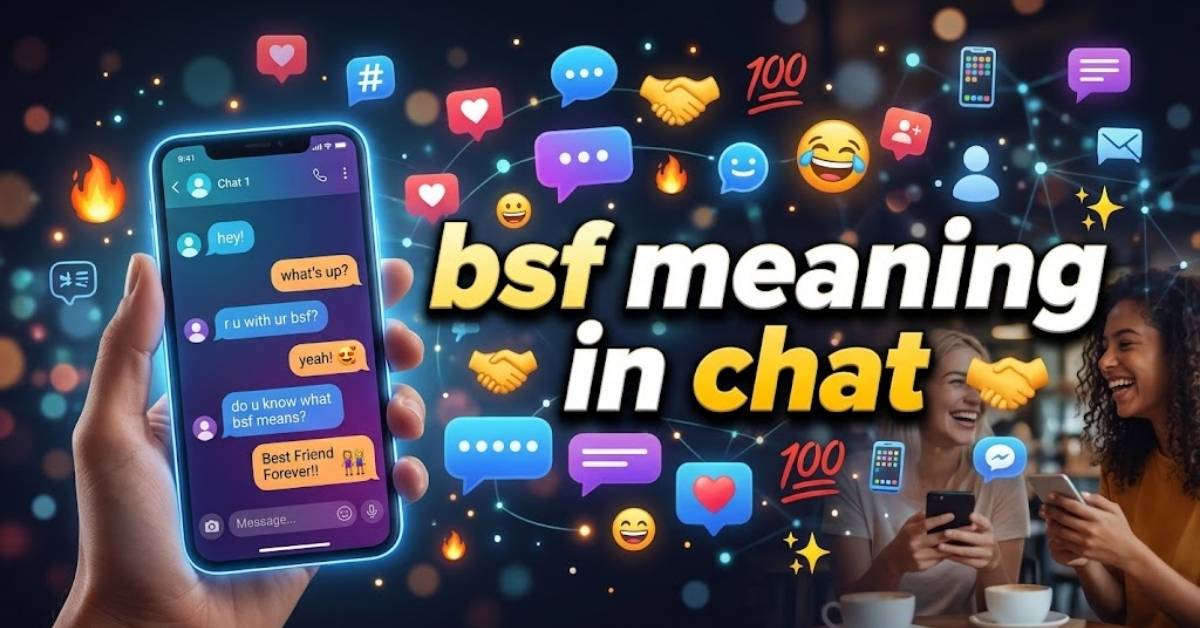
You open a chat, see a message ending with “love you, BSF,” and wonder if you missed something. You did not. The BSF meaning is simple in most online conversations, but the details change with context, tone, and even country.
This guide explains what BSF means, where it came from, and how to use it. It also covers how to reply and when to avoid it.
BSF – Quick Meaning
Simple Definition:
BSF stands for “best friend.” It is an acronym used in texting and social media to describe the person you feel closest to outside your family. Dictionary.com classes it as textspeak and internet slang.
Some people also read it as “best sister friend” or “best sister forever.” The core idea stays the same: a trusted, close bond.
Quick Examples:
- “Happy birthday to my BSF!”
- “Can’t wait to see you tonight, BSF.”
- “NP, bsf!” (No problem, best friend)
- “Shoutout to my BSF for the advice.”
Origin & Background
BSF began as a shortcut. People typing on small phone keyboards and in early social platforms shortened “best friend” to save time. Dictionary.com records BSF for best friend on Twitter by at least December 2009, so the habit is older than many people think.
The same letters also belong to older, unrelated names. Bible Study Fellowship was founded in 1959 by Audrey Wetherell Johnson. India’s Border Security Force is a well known paramilitary force. These meanings existed long before the slang, which is why context matters so much.
Why BSF Became Popular:
- It is fast. Three letters beat two words.
- It feels current. Younger users on TikTok, Snapchat, and Instagram often treat it as fresher than BFF.
- It sounds direct. BFF promises “forever.” BSF simply states who someone is to you today.
- It fits captions. Short tags work well under photos and in comments.
Real-Life Conversations
Seeing BSF in action makes the meaning easier to remember.
WhatsApp Chat
Aisha: Did you reach home safely?
Sana: Yes, just got in. Thanks for checking, BSF.
Aisha: Always. Text me tomorrow.
Here BSF is a warm sign-off between two close friends.
Instagram DM
Zoya: Your story made me laugh so hard.
Hira: That was for you, BSF. Remember that trip?
The term adds personality to a quick reply.
Text Message
Ali: Need a ride to the exam?
Usman: Pick you up at 8, BSF.
In this case BSF shows loyalty and reliability, not romance.
Emotional & Psychological Meaning
A label like BSF says more than the letters. Calling someone your BSF signals three things:
- Trust: You share private thoughts with them.
- Priority: They sit near the top of your social circle.
- Safety: You can be yourself without being judged.
Psychologists who study friendship often point to close peer bonds as a key source of support, especially in teens and young adults. A short tag like BSF is a low pressure way to say “you matter to me” without a long speech.
It can also carry a hint of exclusivity. Some people feel uneasy when the label is given too freely or to someone new. That feeling is normal.
Usage in Different Contexts
1. Social Media
On TikTok, Instagram, and Snapchat, BSF appears in captions, comments, and story tags. Typical lines include “BSF goals” or “me and my BSF.” It is public, so it works as a friendly announcement.
2. Friends & Relationships
Among friends, BSF is affectionate and personal. It is often used after support, jokes, or shared memories. In a romantic relationship, it is not a pet name for a partner, though someone might call a partner their “best friend” in full.
3. Work or Professional Settings
Avoid BSF in emails, reports, and formal chats. A close colleague might use it in a private joke, but it still reads as slang. If you work in India, remember that BSF may refer to the Border Security Force in official or news contexts.
4. Casual vs Serious Tone
- Casual: “Thanks, BSF!” is light and playful.
- Serious: “You’re my BSF and I trust you with this” shows real emotional weight.
Tone words, emojis, and the sender’s history help you tell the difference.
Common Misunderstandings
1. Confusing BSF with BFF
BFF means “best friends forever.” BSF usually means “best friend” in the present. Many people use them interchangeably, but BFF sounds more sentimental and classic.
2. Assuming It’s Always Serious
Not every BSF is deep. People often use it jokingly with a friend they met recently or with a group chat full of “best friends.”
3. Using It Too Early
Calling someone your BSF after one or two chats can feel forced. The label usually follows time, trust, and shared experiences.
4. Thinking It’s Formal
BSF is informal slang. It does not belong in a cover letter, a client email, or an academic paper.
Comparison Table
| Term | Full Form | Tone | Common Use |
|---|---|---|---|
| BSF | Best friend | Warm, current | Texts, captions, comments |
| BFF | Best friends forever | Sentimental | Cards, posts, texts |
| BFFL | Best friends for life | Very strong | Personal messages |
| Bestie | Best friend (nickname) | Playful | Speech and text |
| BF | Boyfriend | Romantic | Relationship talk |
Key Insight:
BSF, BFF, and bestie all point to a close friend. The difference lies in tone, not meaning. Also watch for typos: BF means boyfriend, so one missing letter changes the message completely.
Variations / Types of BSF Usage
- BSFs: Plural, for more than one best friend.
- BSF4L: Best friend for life.
- Best Sister Friend / Best Sister Forever: Used between women or close female friends.
- BSF energy: A joke phrase for loyal, supportive behavior.
- But Seriously Folks: A rare online chat usage to return to a serious point.
- Border Security Force and Bible Study Fellowship: Non-slang meanings tied to news and religious settings.
How to Respond When Someone Uses BSF
Casual Replies
- “Always, BSF!”
- “Same to you.”
- “You know I’ve got you.”
Funny Replies
- “BSF? Does this mean you’ll pay for lunch?”
- “Careful, I might frame this message.”
- “Promoted to BSF after that snack, I see.”
Mature/Confident Replies
- “That means a lot to me. I value our friendship too.”
- “Thank you. I’m glad we have each other.”
Private/Respectful Replies
- “I appreciate that. Let’s talk more soon.”
- “Thanks for saying that. I’m grateful for you.”
Use this style if you are not ready to use the same label back.
Regional & Cultural Usage
Western Culture
In the US, UK, and Canada, BSF is mostly seen among teens and young adults online. It sits next to bestie and BFF as part of everyday texting slang.
Asian Culture
In India, many people first link BSF with the Border Security Force. In casual youth chats and social media, though, the best friend meaning is widely understood. In Pakistan and nearby regions, English slang like BSF appears mainly in mixed English and local language chats.
Middle Eastern Culture
English texting slang is common among younger, bilingual users. BSF usually appears inside Arabic and English mixed conversations, and tone often follows the local norms of friendship and respect.
Global Internet Usage
Across the global internet, BSF means best friend in most informal chats. When you see it in news, government, or church contexts, think of the organization instead. When unsure, check who wrote it and where.
FAQs
1. What does BSF mean in texting?
BSF means “best friend.” It is a casual abbreviation used between close friends.
2. Is BSF the same as BFF?
They are very close. BFF means “best friends forever,” while BSF usually just means “best friend.”
3. Can BSF mean boyfriend?
No. Boyfriend is BF. A typo can cause confusion, so check the context.
4. Is it okay to use BSF in professional settings?
Generally no. BSF is informal slang, so use “close friend” in formal writing.
5. Why do people use BSF instead of best friend?
It is shorter, quicker to type, and feels natural in modern chat culture.
6. Can you have more than one BSF?
Yes. Some people have several BSFs, and the plural form is BSFs.
7. Is BSF only used by teenagers?
No. Teens use it most, but adults also use it in casual chats and captions.
Conclusion
The BSF meaning is simple: best friend. Its weight depends on who says it, where, and in what tone. Among friends, it is a quick way to show love and loyalty. Online, it fits captions and DMs. In news or religious settings, it may mean something entirely different.
Read the context, match the tone, and when in doubt, ask. That small step keeps your conversations clear, warm, and genuine.
