

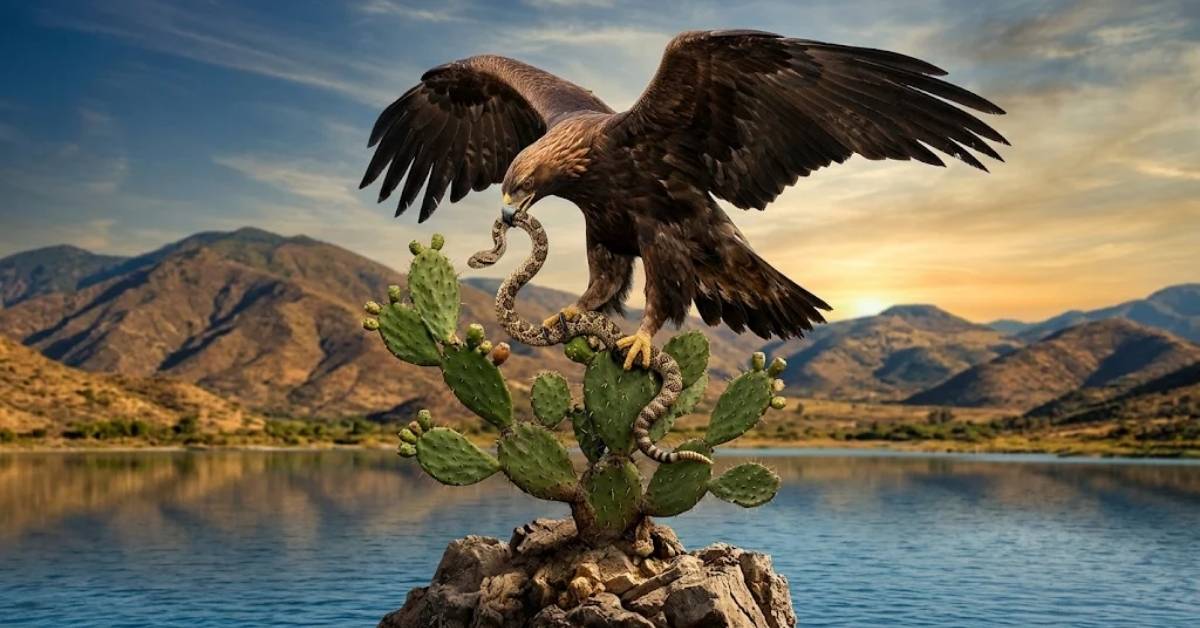
Look at the center of the Mexican flag and you will see an eagle perched on a cactus, holding a snake in its beak. It looks simple, but almost every part of this image carries a story that is more than 700 years old.
The symbol on the Mexican flag is the national coat of arms. It comes from an Aztec (Mexica) founding legend about a promised land, a sign from a god, and the birth of Tenochtitlan, the city that became modern Mexico City.
In this guide you will learn what each part means, how the design changed over time, and which myths people still get wrong. You will also see how people talk about it online today.
What Does the Symbol on the Mexican Flag Mean? – Quick Meaning
The symbol on the Mexican flag shows an eagle devouring a snake while standing on a prickly pear cactus (nopal) that grows from a rock in a lake. It represents the founding legend of Tenochtitlan, the Aztec capital, and today stands for Mexican identity, resilience and national pride.
Here is the short version:
- Eagle: The sun god Huitzilopochtli and the strength of the Mexica people
- Snake: Wisdom and the old world in Aztec thinking, later read as evil in colonial times
- Nopal cactus: The island where Tenochtitlan was built
- Lake and rock: The setting of the sign, Lake Texcoco
- Oak and laurel branches: Strength and victory, tied with a ribbon in the flag colors
Origin Background
The story starts with the Mexica, who traveled for generations looking for a home. According to the legend, their god Huitzilopochtli told them to settle where they found an eagle on a nopal cactus devouring a snake.
Historians widely place the founding of Tenochtitlan around 1325. The sign appeared on a small island in Lake Texcoco, in the Valley of Mexico. Scholars such as archaeologist Eduardo Matos Moctezuma see the tale as a symbolic retelling of real history, not a literal prophecy.
Later, Spanish authorities gave Mexico City an emblem based on this image in 1523. After independence in 1821, it moved onto the national flag. The present version was officially established in 1968 and drawn by artist Francisco Eppens Helguera.
Why the Eagle Became So Important
The eagle is the heart of the design. The Mexica called themselves the People of the Sun, and the eagle was linked to Huitzilopochtli, the sun and war god.
For the Mexica, the bird showed power, courage and a divine promise. For modern Mexico, it shows sovereignty and independence.
Which bird is it? The golden eagle is considered Mexico’s national bird. In 1960, ornithologist Rafael Martín del Campo argued that the bird in the old codex looks more like a crested caracara, a member of the falcon family. This debate shows the symbol is a cultural image, not a biology lesson.
The Meaning of the Cactus
The cactus is a nopal, also called prickly pear. It grows in dry, rocky land, which is a strong picture of survival in hard places.
In the legend, the nopal marks the island of Tenochtitlan. Its red fruit, called tuna, is tied to the heart of Copil, a figure from Mexica myth. The cactus sits on a rock set in water, a glyph that echoed the name of the city.
Nopal is still part of daily Mexican life today. People eat it, cook with it and use it in traditional medicine, so the symbol feels close to home.
The Snake and Its Interpretation
The snake is the most debated part of the emblem. In Mexica thought, serpents were tied to wisdom, earth and the god Quetzalcoatl, the feathered serpent. They were not simply evil.
Colonial friars later reshaped the image. Some, such as Diego Durán, read the eagle as good defeating the snake as sin. Curator Guadalupe Lozada has said the eagle and cactus were adopted by Europeans in the mid 16th century, and the serpent was added decades later.
Today, many Mexicans see the scene as a victory of resolve over hardship. Others prefer the older reading. Both views are part of the symbol’s story.
Social Media and Modern Meaning
Online, the emblem appears in memes, football fan posts, Independence Day captions and tattoo photos. Posting it often says “I am proud of my roots,” especially among Mexican communities in the United States.
In 2025, Mexico City marked 700 years since the founding of Tenochtitlan. That anniversary pushed the legend back into news feeds and school lessons, and gave a new wave of explainers and exhibits.
Real-Life Conversations
Here are four realistic chats showing how people talk about the symbol.
WhatsApp Conversation
Lucas: Why is there a snake on the Mexican flag? It looks wild. Sofia: It comes from an Aztec legend. A god told them to build their city where they saw an eagle on a cactus eating a snake. Lucas: So that is how Mexico City started? Sofia: Yep. Tenochtitlan, around 1325.
Instagram DM
Maya: Just got an eagle and nopal tattoo. Is it disrespectful? Diego: Not if you know the story. It is our founding legend, so wear it with pride. Maya: I read all about it first. I wanted it to mean something.
TikTok Comments
@history_nerd: The eagle is not “just a bird.” It is the sun god’s sign. @amelia_k: Wait, so the snake is not the bad guy? @history_nerd: Depends who you ask. Aztecs saw wisdom. Colonial writers saw sin.
Text Message
Jordan: Quiz night tomorrow. What does the center of the Mexican flag show? Priya: Eagle, snake, nopal cactus. It is the coat of arms from the Tenochtitlan legend. Jordan: Perfect, thank you.
Emotional & Psychological Meaning
Symbols work because they carry feeling. This one tells a story of a wandering people who found a home, and that story speaks to belonging.
For many Mexicans and people of Mexican heritage, the emblem brings:
- Pride: It links today to a rich Indigenous past
- Resilience: A cactus on a rock in a lake means growth against the odds
- Unity: It sits on a flag shared by millions
- Memory: It reminds people that Tenochtitlan lives beneath modern Mexico City
Psychologists who study national symbols often note that images with a clear story are easier to remember and feel more personal. The eagle scene is a good example, since you can explain it in one sentence.
Usage in Different Contexts
Social Media
On social media, the emblem appears on Independence Day (September 16), Flag Day (February 24) and during sporting events. Use correct captions and credit the legend, not guesses. Short, accurate posts tend to earn more trust.
Friends & Relationships
Among friends, it often starts conversations about heritage, travel and family stories. People share it in group chats, school projects and cultural events. If you are not Mexican, asking questions with curiosity goes a long way.
Work and Professional Settings
In schools, museums, tourism and global businesses, accuracy matters. Use the official design, spell Tenochtitlan correctly, and avoid altering the emblem in marketing. Mexican law has rules about how the national arms may be used.
Casual vs. Serious Tone
A casual tone works for memes and friendly chats, as long as it stays respectful. A serious tone fits education, official events and memorial days. When in doubt, lean formal, because this is a national symbol.
When NOT to Use It
The emblem is not a decoration for every situation. Avoid it when:
- You plan to mock or distort it. Jokes that insult the flag or Mexican people can hurt.
- It would be used on commercial products without care. Official use is regulated, and altered versions may break the rules.
- It is a costume prop for stereotypes. Treat it as a national symbol, not a party gimmick.
- You are unsure of the facts. Do not invent meanings. Check a reliable source first.
- It is part of political attacks. Mixing the national emblem into hate content is disrespectful.
Common Misunderstandings
“The Eagle Only Means Strength”
Strength is part of it, but the eagle also stands for the sun, the divine promise and Mexico’s independence. It is a spiritual and political symbol together.
“The Snake Represents Evil”
Not always. In Mexica culture, serpents were tied to wisdom and sacred ideas. The “evil” reading grew strong after European friars reinterpreted the scene.
“The Symbol Has Always Looked Exactly the Same”
The design has changed many times since 1823, with different eagle poses, snake types and artistic styles. The current version dates to 1968. Older codices show an even simpler scene.
“The Center Image Is Just a Decoration”
It is the national coat of arms, protected by law and rich in history. It is the main feature that separates the Mexican flag from the Italian flag, which has the same three colors.
Comparison Table
| Element | Aztec Meaning | Modern Meaning |
|---|---|---|
| Eagle | Sun god Huitzilopochtli, divine sign | Sovereignty, courage, national pride |
| Snake | Wisdom, earth, link to Quetzalcoatl | Challenges overcome, sometimes seen as evil in colonial readings |
| Nopal cactus | Island of Tenochtitlan, heart of Copil | Survival, resilience, Mexican identity |
| Lake and rock | Lake Texcoco, name glyph of the city | Roots of Mexico City |
| Oak and laurel | Not part of the original legend | Strength and victory |
| Flag colors | Not part of the legend | Green, white and red, linked to independence, unity and faith in official history |
Key Insight
The symbol has layers. The Aztec story, the colonial reading and the modern national meaning exist together, and that mix is exactly why it still feels alive.
How to Respond When Someone Uses It
Casual Replies
- “That is such a cool story, thanks for sharing.”
- “I always wondered about the snake. Good to know.”
- “Love how much history is packed into one image.”
Funny Replies
- “So the eagle really chose violence at dinner.”
- “That cactus has the best real estate in history.”
- “The first city planning meeting was a bird, apparently.”
Mature Replies
- “It is interesting how the legend blends myth with real history.”
- “The symbol feels more meaningful once you know its origin.”
- “Different eras clearly read the snake in different ways.”
Respectful Replies
- “Thank you for explaining. I will share this the right way.”
- “I appreciate you teaching me about your heritage.”
- “That is a powerful symbol. I will be careful to treat it with respect.”
Regional & Cultural Usage
Western Culture
In the United States and Europe, the emblem is mostly seen on Mexican flags, sports gear, murals and Mexican restaurants. It often appears at Cinco de Mayo and Independence Day events. Many non-Mexicans still confuse the two holidays, so a short explainer helps.
Asian Culture
Many Asian countries use birds in national emblems, such as the Garuda of Indonesia and the steppe eagle on Kazakhstan’s flag. The Mexican emblem is known mainly through geography lessons, travel, and food and culture media.
Middle Eastern Culture
The eagle is also a familiar national symbol in the region, such as the Eagle of Saladin on Egypt’s coat of arms. Visitors often compare it with the Mexican eagle, although the stories behind them are very different.
Global Internet Usage
Online, the symbol travels through flag emojis, memes, history videos and travel blogs. Search interest tends to rise around Independence Day, big football matches and anniversaries such as the 700th year of Tenochtitlan.
Gen Z vs. Millennials
- Gen Z: Learns the story through TikTok, short videos and shareable facts. Likes humor and visuals.
- Millennials: More likely to know the legend from school, travel or documentaries. Often share longer posts and heritage stories.
Is It Safe for Kids?
Yes. The symbol is safe and educational for children. Explain it simply: a god told a people to build a city where they saw an eagle on a cactus, and they did. Skip the darker history unless the child is older and asks.
FAQs
What does the symbol on the Mexican flag mean?
It shows an eagle on a cactus eating a snake, based on the Aztec legend of how Tenochtitlan was founded. It stands for Mexican identity, strength and pride.
Why is there an eagle on the Mexican flag?
The eagle represents the sun god Huitzilopochtli, who told the Mexica to settle where they saw one. It became a symbol of independence and national power.
What does the snake on the Mexican flag represent?
To the Aztecs it stood for wisdom and sacred power. Later colonial writers read it as evil defeated by good.
What does the cactus mean on the Mexican flag?
The nopal marks the island of Tenochtitlan in Lake Texcoco. It also stands for survival and resilience.
Is the Mexican flag symbol an Aztec symbol?
Yes, it comes from Aztec (Mexica) legend, though its current look was shaped by Spanish colonial and modern Mexican history.
What is the bird on the Mexican flag?
It is usually described as a golden eagle, though some experts say the codex bird may be a crested caracara.
Why is the Mexican coat of arms important?
It tells the origin story of Mexico City and unites Indigenous heritage, history and modern national identity. Its use is protected by law.
Conclusion
The symbol on the Mexican flag is much more than an eagle, a snake and a cactus. It is a founding story, a religious sign, a colonial reinterpretation and a modern emblem of pride, all in one picture.
Once you know the legend of Tenochtitlan, the flag feels different. The eagle shows strength and a divine promise, the cactus shows survival, and the snake invites more than one reading. Share the story accurately, treat the emblem with respect, and you will help keep its meaning alive.
