

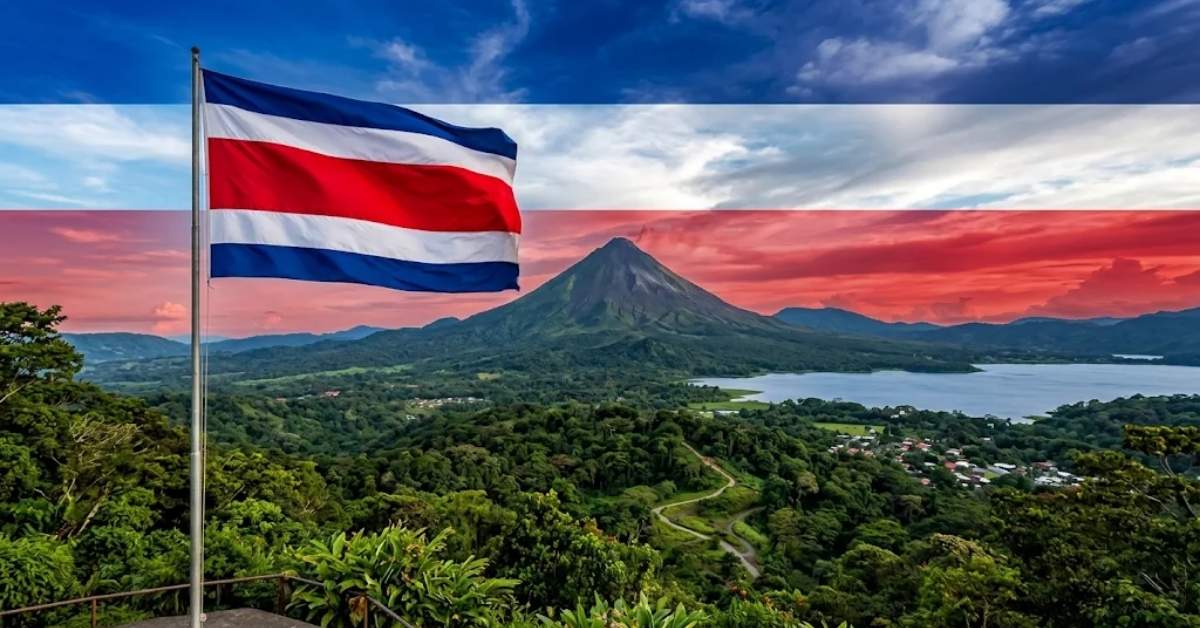
Few national flags look as clean as the Costa Rica flag. Five stripes, three colors, and a story that starts with a first lady and a revolution in France. Yet most pages repeat the same short list of color meanings and skip the parts people actually search for. Why are there two versions? What does the little emblem hold? And what does someone mean when they send 🇨🇷 in a chat?
This guide covers all of it. You will get the quick meaning, the real history, the coat of arms explained, and practical advice for using the flag symbol online and offline. Facts here come from encyclopedic and travel sources, and where sources disagree, I say so.
Costa Rica Flag Symbol Meaning – Quick Meaning
The Costa Rica flag has five horizontal stripes: blue, white, red, white, blue. The red center stripe is twice as wide as the others. The colors stand for the sky (blue), peace (white), and the blood of those who died for freedom (red).
The colors at a glance:
- Blue: the sky, and by extension opportunity, perseverance and spiritual ideals.
- White: peace, clear thinking and wisdom.
- Red: the sacrifice made for freedom, plus the warmth and generosity of the Costa Rican people.
Here is a detail most blogs blur together. The short version (sky, peace, blood shed for freedom) is the one tied to national law and official descriptions. The longer lists with words like happiness, beauty and opportunity are popular interpretations. Both are fair to share, but they are not the same thing.
Quick facts:
- Adopted: 29 September 1848
- Proportion: 3:5
- Stripe ratio: 1:1:2:1:1
- Colors: Reflex Blue, a bright red (Pantone 485 C), and white
- Flag Day: 12 November
- Emoji: 🇨🇷
Origin & Background
Costa Rica declared independence from Spain in 1821. Before that, it was a province under the Captaincy General of Guatemala and had no flag of its own.
How the design developed:
- 1823 to 1841: Costa Rica flew the blue, white, blue banner of the Federal Republic of Central America, often with a local seal.
- About 1840 to 1842: After the federation broke apart, a white, blue, white version appeared with the words “Estado de Costa Rica.”
- 29 September 1848: The current flag was adopted under President José María Castro Madriz.
The design is credited to his wife, Pacífica Fernández Oreamuno. She admired the ideals of the 1848 French Revolution and suggested adding a red stripe. The blue was darkened too. The result echoes the French tricolor and its themes of liberty, equality and fraternity.
The Two Versions of the Flag
Costa Rica uses two flags, and mixing them up is a common mistake.
- Civil flag (Bandera): five stripes, no emblem. Anyone can fly it.
- State flag (Pabellón Nacional): the same stripes plus the national coat of arms on a white oval, set toward the hoist side. It is meant for government buildings, official ceremonies and military use.
According to Tico Travel, private homes should not fly the emblem version, with the exception of Flag Day on 12 November.
The Coat of Arms Explained
The emblem is a small story of the country in one picture.
- Three volcanoes: often explained as the country’s mountain ranges.
- Two oceans: the Pacific and the Caribbean.
- Merchant ships: trade and cultural exchange.
- Rising sun: prosperity and a bright future.
- Seven stars: the seven provinces (San José, Alajuela, Cartago, Heredia, Guanacaste, Puntarenas and Limón).
- Myrtle branches: peace and victory.
- Ribbons: “República de Costa Rica” in gold and “América Central” in silver.
- Small gold circles: coffee beans, a nod to the crop that built the early economy.
The emblem has been revised several times, in 1906, 1934 and 1964, with smoke added to the volcanoes in 1998. Some sources list slightly different details, so treat exact dates for minor edits with care.
How to Spot a Look-Alike
Thailand’s flag looks similar at a glance. It uses red, white and blue, but the order is reversed: red, white, blue, white, red. On Costa Rica’s flag, blue sits on the outside and red in the middle.
Real-Life Conversations
In 2026, most people meet this symbol as the flag emoji. Here is how 🇨🇷 tends to show up in real chats. These are illustrative examples, not quotes from real users.
Maya: Booked! Flights to San José are sorted Leo: 🇨🇷🔥 Finally. Surf lessons are on me
Here the flag means excitement about a trip. It works as a travel marker.
Instagram DMs
Sofia: Your photos from Manuel Antonio are unreal Diego: 🇨🇷 pura vida, my friend
In this case the flag signals home pride. “Pura vida” is the national phrase for a relaxed, grateful outlook, and the emoji often travels with it.
TikTok Comments
@coffeefan: Is this beans from Tarrazú? @fincatico: 🇨🇷☕ 100%
Under food, coffee and nature videos, the flag works as a quick label of origin.
Text Message
Ana: Watching the match tonight? Carlos: 🇨🇷 all the way, vamos Ticos
During football season, it becomes a cheer for the national team.
Tech tip: On some Windows systems, flag emojis display as two letters, “CR,” instead of a flag. This is a font display issue, not a different meaning.
Emotional & Psychological Meaning
Flags carry feelings fast. A single glance at blue, white and red can signal belonging, pride or memory without a word.
For Costa Ricans, the flag often carries peace. The country abolished its army in 1948 and redirected resources toward education and health, a point many citizens treat as part of national identity. The white stripe and the myrtle branches fit that story well.
For visitors, 🇨🇷 usually carries warmth, nature and relaxation: rainforest, beaches, coffee and the easy-going spirit of pura vida.
Personal-Style Scenario
Imagine you studied abroad in San José for a semester. Years later, a friend from that trip texts you a lone 🇨🇷. There is no caption. You feel the reply before you write it: the host family dinners, the rainy afternoons, the bus rides. That is what a symbol does. It compresses a shared memory into one character.
If you are the one sending it, ask yourself one question: does the person know what it means to me? If yes, send it alone. If not, add a few words.
Usage in Different Contexts
Social Media
On social platforms, 🇨🇷 appears in bios, travel posts, coffee content, football updates and expat communities. Hashtags often pair it with #PuraVida or #VisitCostaRica. Use it as a location tag, not as a replacement for context.
Friends & Relationships
Between friends and partners, the flag can mean a shared trip, a heritage connection or a plan. Couples may use it to mark an anniversary spot. It is warm and low risk.
Work / Professional Settings
In professional chats, the flag is fine for:
- Introducing your location or team (for example, “Team Costa Rica 🇨🇷”)
- Tagging a market or a regional campaign
- Sharing news about a Costa Rican client or partner
Keep it to one emoji and add clear text. Do not use a flag in place of a country name in formal emails.
Casual vs Serious Tone
- Casual: one flag, maybe with ☕ or 🌴.
- Serious: use the full name “Costa Rica” in writing. If you show the actual flag in a presentation, use the correct version and display it with respect.
When NOT to Use It
Skip the flag symbol in these cases:
- Jokes about the country or its people. Flags are tied to identity.
- Political arguments. A flag in a heated thread can read as a taunt.
- Formal documents. Use the country name.
- Product designs that imply government endorsement. The state flag with the coat of arms is for official use.
- Disrespectful physical treatment. Do not let a real flag touch the ground, and do not use it as a rug, costume trim or disposable decoration.
- Unclear context. If the reader may not recognize it, add words. Costa Rica’s flag is sometimes confused with other tricolors.
Tico Travel also notes that insulting national symbols can carry legal penalties in Costa Rica, so treat the flag with care when you are inside the country.
Common Misunderstandings
- “Red means anger.” In this flag, red points to sacrifice for freedom and to warmth, not aggression.
- “It was adopted in 1906.” Some pages say this. The color design dates to 1848. The year 1906 relates to a coat of arms change.
- “Every Costa Rica flag has the emblem.” No. The civil flag has none.
- “The blue stripes are the same as the old Central American flag.” The blue is darker now, and the red center is the big change.
- “The color meanings are written in stone.” The core meaning is stable, but wording varies by source.
- “It is the same as Thailand’s flag.” Similar palette, reversed order and different history.
- “The emblem shows one volcano.” It shows three.
Comparison Table
| Element | Official or core meaning | Popular interpretation | Common use in chats |
|---|---|---|---|
| Blue | The sky | Opportunity, perseverance | Calm, travel, sea and sky |
| White | Peace | Wisdom, happiness | Peaceful or friendly tone |
| Red | Blood shed for freedom | Warmth, generosity | Passion, pride, team spirit |
| Coat of arms | Provinces, land and seas | Prosperity, trade | Not usually shown in emoji |
| 🇨🇷 emoji | National flag | Pura vida, coffee, nature | Trips, football, home pride |
Key Insight
The colors never mean just one thing. The official meaning gives the flag its foundation, and popular readings give it personality. When you write about the Costa Rica flag, lead with the official meaning and add the popular ones as context.
How to Respond When Someone Uses It
Casual Replies
- “Love that! When are you going?”
- “🇨🇷 Take me with you!”
- “Costa Rica again? You are living the dream.”
Funny Replies
- “Say ‘pura vida’ one more time and I am packing.”
- “That flag just made my Monday worse. I am stuck at my desk.”
- “Is this a hint? Because I will bring the sunscreen.”
Mature Replies
- “Great choice. It is one of the most biodiverse places in the world.”
- “Costa Rica has an impressive record on conservation. How long will you stay?”
Respectful Replies
If the sender is from Costa Rica or has family there:
- “That is a beautiful flag. Tell me about your home.”
- “Thanks for sharing this. What do you miss most?”
- “Happy Flag Day if you are celebrating.”
Regional & Cultural Usage
Western Culture
In the United States, Canada and Europe, 🇨🇷 is mostly tied to travel, eco-tourism, coffee and retirement dreams. It is a positive, light symbol.
Asian Culture
In Asia, the flag usually appears in football, travel and trade contexts. Because it shares colors with the Thai flag, some viewers may need a second look. Add a label if the audience is mixed.
Middle Eastern Culture
Usage is limited, and mostly tied to sports, global news, coffee import trade or travel content. There are no special taboos, but plain, neutral wording works best.
Global Internet Usage
Online, the flag works as shorthand for “I am in Costa Rica,” “I love Costa Rica,” or “this is from Costa Rica.” Football, remote work and wellness communities use it often. Many digital nomad groups use 🇨🇷 as a signal of location.
Generational Differences
- Gen Z: uses it as a vibe tag, often with 🌴 or 🌊, and sometimes with lowercase captions.
- Millennials: treat it as a travel or honeymoon marker.
- Gen X and Boomers: more likely to use the flag in a literal sense, such as national pride, heritage or retirement plans.
Is It Safe for Kids?
Yes. The Costa Rica flag symbol is safe and age-appropriate. It has no violent, adult or hateful meaning. It is a great teaching tool for geography, history and basic color symbolism. A fun classroom activity is to compare it with the French tricolor and discuss why a first lady’s idea still shapes a national symbol today.
Parents should simply remind children to treat any real flag with respect.
FAQs
What does the Costa Rica flag symbol mean?
It represents the sky (blue), peace (white) and the blood shed for freedom (red), with added ideas of opportunity, wisdom and warmth.
Who designed the Costa Rica flag?
Pacífica Fernández Oreamuno, wife of President José María Castro Madriz, proposed the red stripe in 1848.
When was the Costa Rica flag adopted?
The current design was adopted on 29 September 1848.
Why does the Costa Rica flag have a red stripe?
The red was added to reflect French Revolution ideals and became a symbol of sacrifice and warmth.
What do the seven stars on the coat of arms mean?
Each star stands for one of Costa Rica’s seven provinces.
What is the difference between the civil and state flags?
The civil flag has stripes only. The state flag adds the coat of arms and is for official use.
Does the 🇨🇷 emoji mean the same thing as the flag?
Yes. It represents the country and is mostly used for travel, pride, coffee and sports.
Conclusion
The Costa Rica flag symbol meaning is simple on the surface and rich underneath. Blue for the sky, white for peace, red for sacrifice and warmth. Behind it sits a first lady with a bold idea, a French revolution that inspired her, and a coat of arms that tells the story of two oceans, three volcanoes and seven provinces.
Whether you see it on a government building, a coffee bag or a WhatsApp chat, you now know what it really represents. Use it with context, respect it in its physical form, and share the official meaning first. That small habit makes your writing, your conversations and your travel plans a little more informed.
