

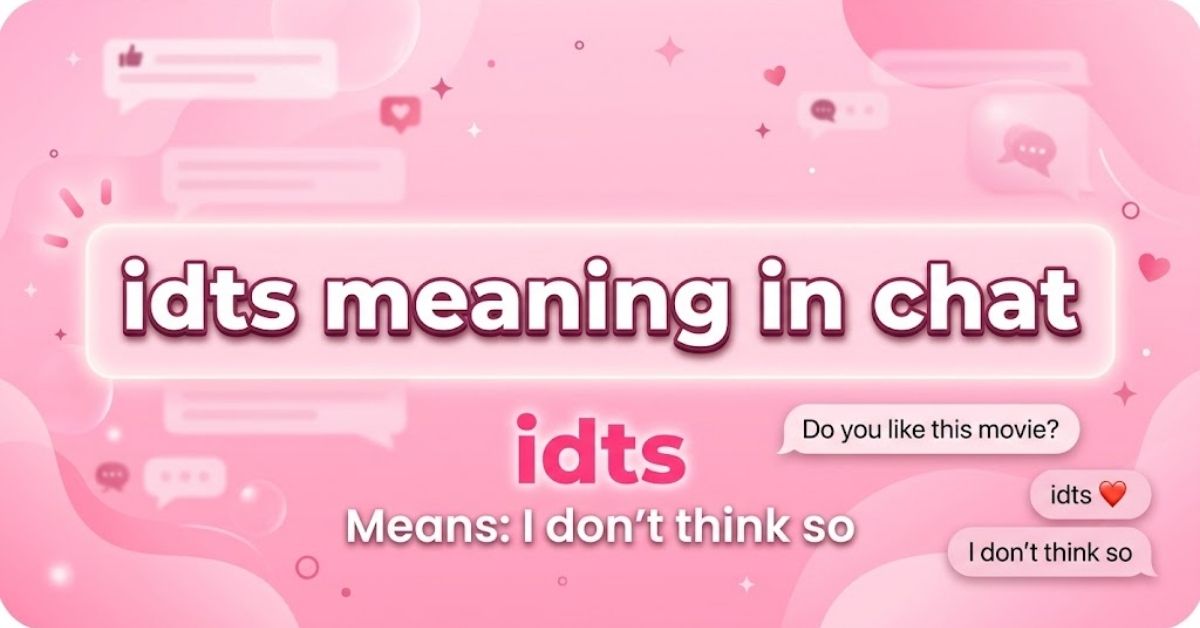
IDTS is a popular texting abbreviation that stands for “I Don’t Think So.” People use it in everyday conversations to express doubt, disagreement, or uncertainty. You might see it in WhatsApp messages, Instagram DMs, TikTok comments, or casual text messages. Instead of typing a complete sentence, someone can use IDTS to share their opinion quickly. However, its tone depends on the situation. It can sound friendly, playful, doubtful, or slightly dismissive. For example, a friend might reply “IDTS 😂” when you make an unlikely prediction.
Understanding internet slang helps you follow online conversations without confusion. You may also encounter related expressions like IDK, LOL, and SMH, which serve different purposes. If you’re searching for what does smh mean, it stands for “Shaking My Head.” Although both abbreviations express reactions, IDTS communicates doubt while SMH often signals disbelief or disappointment. Knowing the difference helps you understand messages and respond naturally.
IDTS Meaning – Quick Definition

IDTS stands for “I Don’t Think So.” People use this texting abbreviation when they disagree, doubt something, or believe something probably won’t happen. It’s common in text messages, social media comments, and casual online conversations. The exact meaning depends on the situation and the sender’s tone.
For example, a friend might use IDTS to express doubt without starting an argument. Someone else might use it to disagree with a statement.
- Full form: I Don’t Think So
- Meaning: Doubt, disagreement, or uncertainty
- Tone: Casual, doubtful, or sometimes sarcastic
- Common platforms: WhatsApp, Instagram, TikTok, and SMS
Example conversation:
Person A: “Do you think we’ll win tomorrow?”
Person B: “IDTS. The other team is really good.”
Here, IDTS expresses doubt rather than anger.
Simple Examples
IDTS makes everyday conversations shorter and quicker. People often use it when they don’t believe something will happen or agree with another person’s opinion. However, the surrounding words can change its tone.
- “Will he come today?” — “IDTS.”
- “This movie will win an award.” — “IDTS, honestly.”
- “Do you think she’s upset?” — “IDTS. She seems fine.”
- “We’ll finish everything in ten minutes.” — “IDTS 😂”
Conversation example:
Person A: “I think our teacher will cancel the test.”
Person B: “IDTS. We should still prepare.”
The reply shows doubt while encouraging the other person to stay prepared.
Origin & Background of IDTS
IDTS developed as part of internet slang and casual digital communication. Like many texting abbreviations, it shortens a common phrase into four letters. People use it to respond quickly without typing a complete sentence.
Its use fits the broader evolution of online language, including SMS texting, online forums, chat rooms, and messaging apps. Character count limits once encouraged shorter messages. Today, convenience and familiar texting habits continue to shape how people communicate.
Unlike some slang terms, IDTS doesn’t require a complicated explanation. Its meaning comes directly from the phrase “I Don’t Think So.” There isn’t a single widely established origin date that can be confidently assigned to the abbreviation.
Why It Became Popular
IDTS fits the fast pace of everyday conversations. It lets people express doubt without writing a long explanation.
Common reasons for its use include:
- Saving time while texting.
- Expressing disagreement in a few letters.
- Responding quickly in group chats.
- Keeping casual conversations relaxed.
- Adding a playful or uncertain tone.
Example conversation:
Person A: “Do you think this trend will last all year?”
Person B: “IDTS. People move on pretty quickly.”
The abbreviation keeps the exchange brief and natural.
Real-Life Conversations Using IDTS
Real-life conversations make the meaning of IDTS easier to understand. The abbreviation usually expresses doubt, disagreement, or a belief that something probably won’t happen. Its tone may sound friendly, neutral, or dismissive depending on the relationship.
You’ll often see IDTS in private messages, social media discussions, and everyday texting. It can stand alone as a short reply or appear within a longer sentence.
Here are some examples showing how people might use it across different platforms.
WhatsApp Conversation
Example:
Person A: “Do you think Ali will remember my birthday?”
Person B: “IDTS 😂 You might need to remind him.”
Person B doubts that Ali will remember the birthday. The laughing emoji makes the reply feel playful rather than harsh.
Instagram DM Conversation
Example:
Person A: “I think she’s going to post another selfie today.”
Person B: “IDTS. She hasn’t posted anything all week.”
The response expresses doubt based on recent behavior. The sender gives a simple reason instead of disagreeing without context.
TikTok Comments
Example:
User 1: “This dance challenge will disappear tomorrow.”
User 2: “IDTS. Everyone is doing it right now.”
The second user disagrees with the prediction. This example shows how IDTS can appear in public comments and discussions about social media trends.
Text Message Example
Example:
Person A: “Will you finish your homework before dinner?”
Person B: “IDTS. I still have two chapters left.”
Here, IDTS communicates uncertainty about finishing on time. The explanation makes the message clearer and more helpful.
Emotional & Psychological Meaning Behind IDTS
IDTS does more than shorten a sentence. It communicates a person’s judgment, uncertainty, or disagreement. In digital communication, people often rely on short expressions to share their thoughts without explaining every detail.
Depending on the situation, IDTS may suggest mild frustration, skepticism, or a playful refusal to agree. However, it doesn’t automatically reveal the sender’s emotional state. A short reply can reflect a genuine opinion rather than a strong feeling.
The psychological meaning comes from the words, relationship, and surrounding conversation. Emojis and follow-up explanations can also help readers understand the intended tone.
What It Reflects About Modern Communication
IDTS reflects the preference for quick, direct messages in online conversations. People often choose short internet expressions when a longer response feels unnecessary.
It can help people:
- Express disagreement without lengthy explanations.
- Respond quickly during busy conversations.
- Share uncertainty without making a firm claim.
- Keep casual exchanges moving.
- Avoid repeating familiar phrases.
Example conversation:
Person A: “I’m sure the shop is still open.”
Person B: “IDTS. It usually closes at nine.”
The reply challenges the assumption and provides useful context. That’s a practical example of concise digital communication.
Usage in Different Contexts
IDTS works best when the conversation feels informal. You might see it in private messages, social media discussions, or chats with friends. However, its meaning and tone can shift according to the situation.
Before using it, consider who will read your message and what you want to communicate. A short abbreviation may feel natural to one person but unclear to another.
1. Social Media
On social media, IDTS often appears in comments, reaction posts, and conversations about trends. People use it to disagree with predictions or express doubt about someone’s claim.
Example:
User A: “This song will be number one next week.”
User B: “IDTS. There are too many popular releases.”
The response expresses an opinion without needing a long explanation.
2. Friends & Relationships
Friends often use IDTS when joking, making plans, or discussing everyday situations. Its tone usually depends on how well the people know each other.
- “Will you wake up at six?” — “IDTS 😂”
- “Do you think he’ll call?” — “IDTS, but let’s wait.”
Example conversation:
Person A: “You think I’ll win this game?”
Person B: “IDTS, bro. You’re playing against the champion.”
Among friends, humor can soften the disagreement.
3. Work or Professional Settings
IDTS may feel too casual for formal emails, business proposals, or messages to unfamiliar colleagues. A direct abbreviation can also sound dismissive when someone expects a thoughtful answer.
In workplace chats, consider writing the full phrase or explaining your reasoning.
Instead of:
“IDTS. That won’t work.”
Try:
“I don’t think that approach will work because we have limited time.”
The second response communicates disagreement more clearly and professionally.
4. Casual vs Serious Tone
IDTS can sound playful, neutral, or critical. Context makes the difference.
| Tone | Example | Likely meaning |
| Casual | “IDTS lol” | Friendly doubt |
| Neutral | “IDTS. We need more information.” | Reasoned disagreement |
| Sarcastic | “IDTS, genius 🙄” | Mocking disagreement |
| Serious | “IDTS. The evidence says otherwise.” | Firm disagreement |
Choose your wording carefully when the conversation involves sensitive issues.
Common Misunderstandings About IDTS
Although IDTS has a simple definition, readers sometimes misinterpret its tone. Short messages leave room for confusion because they lack facial expressions and vocal cues.
A person may intend a harmless disagreement, while the recipient reads it as criticism. The best way to avoid confusion is to consider the context and ask for clarification when needed.
1. Thinking It Means Agreement
IDTS generally means “I Don’t Think So.” It usually expresses doubt or disagreement rather than agreement.
Example:
Person A: “Everyone will love this idea.”
Person B: “IDTS. Some people may disagree.”
The second person challenges the prediction instead of supporting it.
2. Assuming It’s Always Rude
IDTS isn’t automatically rude. Friends may use it jokingly, while others use it to express a sincere opinion. The relationship and wording affect how it sounds.
Example:
Person A: “Will I finish this pizza alone?”
Person B: “IDTS 😂”
This response sounds playful rather than insulting.
3. Using It in Formal Situations
Abbreviations may create confusion in formal communication. Avoid IDTS in professional emails when the recipient expects clear, polished language.
Better alternative:
Instead of “IDTS,” write, “I don’t think that will be possible because of the current deadline.”
This version explains your position and gives the reader more information.
4. Misreading Sarcasm
Sarcasm can change the meaning of an otherwise simple reply. An emoji, exaggerated wording, or previous conversation may signal that the sender is joking.
Example:
Person A: “I studied for five minutes. I’m definitely ready.”
Person B: “IDTS, Einstein 😂”
The response playfully questions the claim. Without the relationship or emoji, it might sound more critical.
Comparison Table: IDTS vs Similar Internet Terms
IDTS belongs to the wider group of texting slang and short internet expressions. However, similar abbreviations don’t always communicate the same idea.
Understanding the differences helps you choose the right expression and avoid confusion.
| Term | Full form | Main meaning |
| IDTS | I Don’t Think So | Doubt or disagreement |
| IDK | I Don’t Know | Uncertainty or lack of knowledge |
| IMO | In My Opinion | Personal viewpoint |
| TBH | To Be Honest | Introducing an honest opinion |
| LOL | Laughing Out Loud | Amusement or laughter |
| SMH | Shaking My Head | Disbelief or disapproval |
| OMG | Oh My God | Surprise or strong reaction |
| WTF | What the … | Shock, confusion, or frustration |
Key Insight
IDTS expresses a belief that something probably isn’t true or won’t happen. IDK means the person doesn’t know the answer. SMH often signals disappointment or disbelief rather than direct uncertainty.
For example:
- “Will it rain?” — “IDK.” The person doesn’t know.
- “Will it rain?” — “IDTS. The forecast says sunshine.” The person doubts it.
- “He forgot his own birthday?” — “SMH.” The person expresses disbelief.
If you’re researching what does smh mean, remember that SMH and IDTS serve different conversational purposes.
Variations and Related Expressions
People don’t always use IDTS in exactly the same way. They may choose longer phrases to express stronger doubt, soften disagreement, or explain uncertainty.
These alternatives share similar meanings, but they aren’t always interchangeable. Some communicate uncertainty, while others suggest a firmer refusal to believe something.
1. IDK About That
This phrase expresses uncertainty or doubt about a claim. It often sounds less definite than IDTS.
Example: “IDK about that. The plan seems risky.”
2. I Doubt It
This phrase expresses stronger skepticism. It works in casual conversations and more direct discussions.
Example: “Will they finish today?” — “I doubt it.”
3. Probably Not
This phrase suggests that something is unlikely to happen. It sounds simple and neutral.
Example: “Are we going out tonight?” — “Probably not.”
4. Not Really
This expression offers a softer disagreement or indicates that something isn’t entirely true.
Example: “Do you like the new design?” — “Not really.”
5. I Don’t Think That’s Right
This phrase directly challenges an idea or statement. It suits conversations that need more clarity.
Example: “The meeting starts at ten.” — “I don’t think that’s right. It’s at eleven.”
6. Maybe Not
This expression leaves room for uncertainty. It sounds less firm than a direct rejection.
Example: “Should we order more food?” — “Maybe not.”
7. I’m Not Sure
This phrase communicates uncertainty without necessarily disagreeing.
Example: “Is the store open?” — “I’m not sure.”
8. Hard to Believe
This expression communicates surprise or skepticism about a claim.
Example: “He finished the whole project overnight.” — “Hard to believe!”
9. Unlikely
This concise response indicates that something probably won’t happen. It often sounds more formal than IDTS.
Example: “Will the package arrive today?” — “Unlikely.”
10. No Way
This phrase can express strong disbelief, surprise, or refusal. Its meaning depends heavily on context.
Example: “They won the competition again!” — “No way!”
How to Respond When Someone Uses IDTS
Your response should match the situation. Sometimes you can joke with a friend. Other times, a thoughtful explanation works better.
Don’t assume that every IDTS message signals hostility. Read the situation, consider the sender’s usual communication style, and respond to the actual point.
Casual Replies
Use these when chatting with friends or people you know well.
- “Fair enough.”
- “Maybe you’re right.”
- “Let’s wait and see.”
- “Could be!”
Example:
Person A: “IDTS. The restaurant will be crowded.”
Person B: “Fair enough. Let’s go earlier.”
Funny Replies
Funny replies work when both people enjoy playful teasing.
- “Wow, zero faith in me 😂”
- “Let me dream!”
- “Challenge accepted.”
- “We’ll see about that!”
Example:
Person A: “You’ll never beat my score.”
Person B: “IDTS? Watch me try!”
Mature / Confident Replies
A calm response helps keep disagreements constructive.
- “I understand your point.”
- “That’s possible, but here’s my reasoning.”
- “Let’s look at the facts.”
- “We may see this differently.”
Example:
Person A: “IDTS. That plan won’t work.”
Person B: “I see your concern. Let’s review the options.”
Private or Respectful Replies
Sensitive conversations deserve extra care. If the message concerns a personal issue, ask what the other person means instead of assuming their intention.
- “Can you explain why you think so?”
- “I understand. Could we talk privately?”
- “Thanks for being honest.”
- “Let’s discuss this calmly.”
Example:
Person A: “IDTS. I don’t think this is a good idea.”
Person B: “I hear you. Can you tell me what’s worrying you?”
Regional & Cultural Usage
IDTS appears in digital conversations across different countries. However, familiarity with English slang varies among communities, age groups, and individuals.
It’s best to avoid assuming that everyone interprets an abbreviation the same way. Cultural expectations, language skills, and personal communication habits can all affect how a message sounds.
Western Culture
In English-speaking online communities, IDTS can appear in casual texts, group chats, and social media discussions. Its meaning usually remains “I Don’t Think So.”
Asian Culture
Some internet users in Asian countries use English abbreviations alongside local languages. Familiarity varies, so a full phrase may be clearer in mixed-language conversations.
Middle Eastern Culture
People who communicate online in English may use IDTS in messages and social media comments. Usage depends on individual habits and familiarity with English slang.
Global Internet Culture
Messaging apps and social platforms help abbreviations cross language borders. Still, a short expression can create a cross-cultural misunderstanding when the reader doesn’t recognize it.
Helpful tip: When communicating with non-native English speakers, write the full phrase if the meaning matters. Clear wording often works better than slang.
Frequently Asked Questions (FAQs)
What does IDTS mean in texting?
IDTS means “I Don’t Think So.” People use it in text messages to express doubt, disagreement, or the belief that something probably won’t happen.
Is IDTS rude?
IDTS isn’t inherently rude. Friends may use it casually, but a blunt reply can sound dismissive depending on the wording and context.
Where is IDTS commonly used?
People use IDTS in SMS texting, WhatsApp chats, Instagram DMs, social media comments, and other informal online conversations.
Is IDTS formal or informal?
IDTS is informal texting slang. In professional emails or formal messages, writing “I don’t think so” usually sounds clearer and more appropriate.
Can IDTS be sarcastic?
Yes. IDTS can sound sarcastic when paired with teasing words, certain emojis, or an exaggerated response. The surrounding conversation helps reveal the intended tone.
What is the opposite of IDTS?
Depending on the context, possible opposites include “I think so,” “probably,” or “I agree.” Each expresses greater agreement or confidence.
Do older people use IDTS?
Yes, some older adults use IDTS, especially if they regularly text or participate in online communities. Familiarity varies by individual rather than age alone.
Conclusion
IDTS is a simple texting abbreviation that stands for “I Don’t Think So.” People use it to express doubt, disagree with an idea, or suggest that something probably won’t happen. You’ll often see it in WhatsApp messages, Instagram DMs, TikTok comments, and everyday online conversations.
Its meaning stays fairly consistent, but the tone can change. A friend might use IDTS playfully, while a colleague could interpret the same reply as dismissive. Context matters.
When you understand the abbreviation, you can recognize it more easily and respond naturally. Use it in casual conversations when it fits. For serious discussions or professional messages, choose clearer wording instead. A few extra words can prevent confusion and help you communicate your point respectfully.
