

You are writing a report, a spreadsheet label, or a quick message, and you need the little bar over the x. Your keyboard does not have it. That is the most common reason people search for the mean symbol.
This guide gives you the symbols to copy, explains what each one means, and shows how people actually use them in chats, classes, and offices. You will also learn the mistakes that make a statistics paper look careless.
Mean Symbol Copy Paste – Quick Meaning
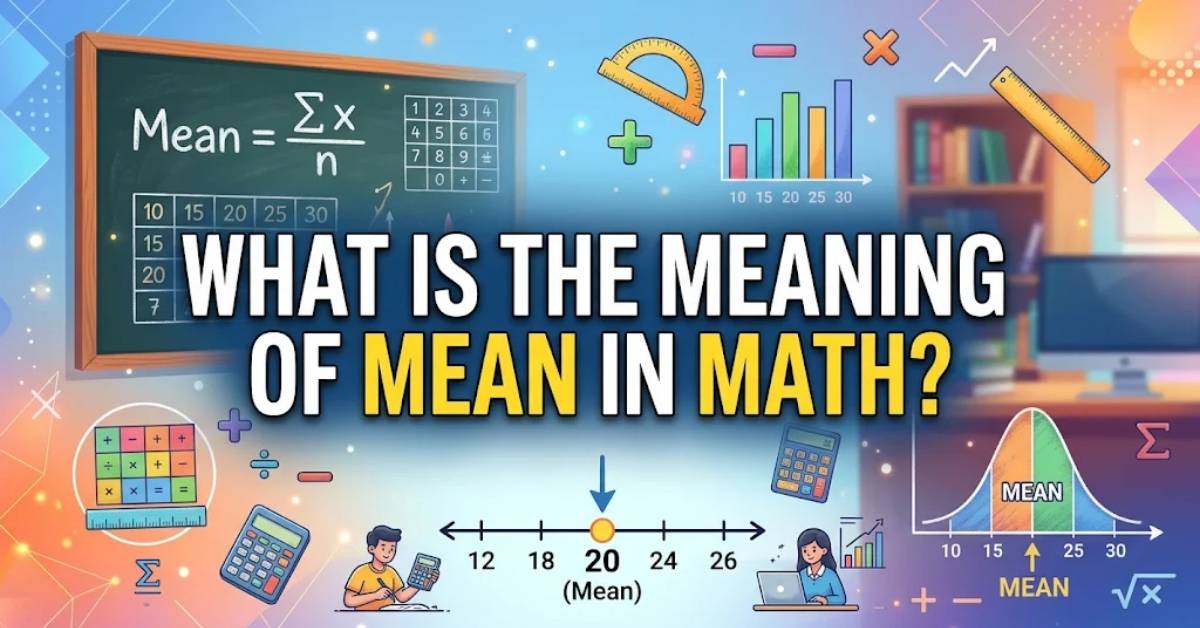
The mean symbol is a mathematical notation for the average of a set of numbers. The two main versions are x̄ (x-bar) for a sample mean and μ (mu) for a population mean.
Copy and paste these symbols:
- x̄ : sample mean (x plus a combining macron)
- x̅ : sample mean (x plus a combining overline, looks slightly different)
- μ : population mean (Greek letter mu)
- ȳ : sample mean of a second variable y
- Σ : summation sign (adds numbers, but is not the mean itself)
- M : the mean in APA style reports
Quick formula: x̄ = Σx ÷ n. Add all values, then divide by the number of values.
Example: For the scores 4, 6, 8 and 10, the sum is 28. Divide by 4 and you get x̄ = 7.
Unicode facts:
- x̄ is the letter x followed by U+0304 (combining macron)
- μ is U+03BC (Greek small letter mu)
- Σ is U+03A3 (Greek capital sigma)
To type x̄ in Word, write x, then 0304, select the four digits, and press Alt + X. In Excel or Google Sheets, a formula like =”x”&UNICHAR(772) returns x̄.
Origin & Background of the Mean Symbol
The idea of an average is very old. Early astronomers and merchants averaged repeated measurements to reduce error. Modern statistical notation took shape much later, as statistics became a formal field in the 1800s and early 1900s.
The bar over a letter became a common way to show “average of this variable.” That is why x̄ is read as “x-bar.” The Greek letter μ was adopted for the true mean of a whole population. Greek letters are traditionally used for population parameters, while Latin letters describe sample statistics.
This split matters. A parameter describes everything in a group. A statistic describes only the part you measured.
Key entities behind the notation:
- Arithmetic mean: the standard average
- Sample mean (x̄): average of the data you collected
- Population mean (μ): average of every member of the group
- Unicode Consortium: the body that keeps these characters standard across devices
- APA style: a format that uses M for the mean in written reports
Real-Life Conversations
The mean symbol shows up outside textbooks more than you may expect. Here are realistic examples of how people use it.
WhatsApp Conversation
Mia: What did you get for the class average?
Sam: x̄ = 72.4. Not bad.
Mia: Wait, is that the whole class or just our group?
Sam: Just our group. So x̄, not μ.
Sam used the correct symbol because the data came from a sample, not the full class.
Instagram DM
Ayaan: Sending you my stats notes. Copy the x̄ from the first page.
Hira: Thanks! My phone shows x̄ with the bar a bit off.
Ayaan: That is a font thing. Try x̅ instead.
This is a very common situation. The combining mark can shift depending on the font.
TikTok Comments
User 1: POV: your mean is x̄ and everyone wants μ
User 2: Sample vs population is my whole personality this semester
User 3: Σ is not the mean, stop it
Study creators often use the symbol as a joke. The humor only works if viewers know the difference.
Text Message
Dad: What does x̄ mean in your homework?
You: It is the average of the numbers. Add them up and divide by how many there are.
Short and plain works best when the other person is not a math person.
Emotional & Psychological Meaning
The mean symbol has no built-in emotion. It is neutral, factual, and precise. Still, people attach feelings to it.
- Confidence: Students who understand x̄ and μ often feel more in control of statistics.
- Anxiety: Others feel stress because the notation looks intimidating, especially under exam pressure.
- Authority: In a report, correct symbols signal care and credibility.
- Belonging: Using the symbol in memes shows you are part of a math or data community.
Math anxiety is real and common. Seeing a symbol you do not recognize can feel like a wall. Learning that x̄ simply means “average of my sample” often removes most of that fear.
One more point: the word “mean” also means unkind in everyday English. The mean symbol has nothing to do with that. If a friend sends x̄ in a chat, they are almost certainly talking about numbers, not attitude.
Usage in Different Contexts
Social Media
On social platforms, people use the mean symbol in study posts, memes, bios, and captions. Data creators, teachers, and students use it to make content look more academic or more playful.
Tips:
- Paste it as plain text in captions, since most apps display Unicode well.
- Avoid using it in usernames, where combining marks can break or disappear.
- Add a short explanation if your audience is not technical.
Friends & Relationships
Among friends, the symbol is mostly an inside joke or a study aid. A group chat about exams might use x̄ to compare scores. Couples who work in science or finance sometimes use it playfully.
Keep the tone light. Sending formulas to someone who did not ask for them can feel like showing off.
Work & Professional Settings
This is where correct use matters most. Analysts, researchers, quality control teams, and healthcare staff use the mean symbol daily.
Good habits:
- Use x̄ for sample data and μ for population data.
- Define the symbol the first time it appears.
- Pair the mean with a measure of spread, such as standard deviation (s or σ).
- Check that your font displays the symbol in PDFs and slides.
Casual vs. Serious Tone
| Situation | Best choice | Why |
| Group chat joke | x̄ | Quick and recognizable |
| Class notes | x̄ or μ | Matches the textbook |
| Research paper | x̄, μ, or M | Follow the required style guide |
| Client report | The word “average” plus x̄ | Clear for non-experts |
When NOT to Use It
Don’t Use It as a Universal “Average” Symbol
The symbol has a specific meaning. If you only have a rough estimate or a median, do not label it x̄. Wrong labels mislead readers.
Don’t Replace μ Without Understanding the Difference
Swapping x̄ and μ changes the claim you are making. x̄ says “this is what my sample showed.” μ says “this is the true value for everyone.” Unless you truly measured the whole population, use x̄.
Avoid It in Audience-Unfriendly Messages
If you are writing to customers, parents, or a general audience, write “average” first. You can add the symbol in brackets if it helps.
Don’t Assume Every Device Displays It Perfectly
x̄ is built from two characters. On some older systems or plain text editors, the bar can drift, split from the x, or show as an empty box. Test your file on another device before sending it.
A safer option is μ, which is a single character. Another is typing “x-bar” in plain text.
Don’t Use It Just for Decoration
Adding a mean symbol to a bio or caption only to look smart can backfire. Followers who know statistics may notice if it is used wrongly.
Common Misunderstandings
“x̄ Is Just the Letter X”
It is not. The bar changes the meaning completely. Plain x usually stands for an individual data value. x̄ is the average of many x values.
“x̄ and μ Always Mean the Same Thing”
They describe the same idea but for different groups. x̄ comes from a sample. μ belongs to a whole population. The sample mean is often used to estimate μ.
“The Mean Is Always the Middle Number”
The middle number is the median. The mean is the balance point of all values. In the set 2, 3, 4, 5, 100, the median is 4 but the mean is 22.8. One extreme value pulled the mean up.
“Σ Is the Mean Symbol”
Σ means “sum of.” It is only part of the mean formula. You still divide by n to get x̄.
Mean Symbols Compared
| Symbol | Name | Meaning | Typical use |
| x̄ | x-bar | Sample mean | Data from a sample |
| μ | Mu | Population mean | Whole group data |
| M | M | Mean in reports | APA style writing |
| Σ | Sigma (capital) | Sum of values | Part of mean formula |
| σ | Sigma (small) | Population standard deviation | Spread, not average |
| s | s | Sample standard deviation | Spread of a sample |
| ȳ | y-bar | Sample mean of y | Regression, paired data |
Key Insight
If you remember one rule, make it this: Latin letters describe samples, Greek letters describe populations. x̄ goes with s, and μ goes with σ.
How to Respond When Someone Uses It
Casual Replies
- “Got it, so that is the average?”
- “Nice, what was the sample size?”
- “Thanks, I will copy that into my notes.”
Funny Replies
- “x̄ marks the spot.”
- “I was average at math until you explained this.”
- “Mean, median, mode, and now my brain is in outlier mode.”
Mature Replies
- “Is that the sample mean or the population mean?”
- “Do you have the standard deviation too?”
- “Could outliers be affecting that mean?”
Respectful Replies
- “Thanks for clarifying. I was not sure what x̄ meant.”
- “Could you explain how you calculated it?”
- “That helps. I will use the same notation in my report.”
Regional & Cultural Usage
Statistical notation is one of the most shared languages in education. The symbols themselves are largely the same worldwide, though classroom habits and writing direction differ.
Western Culture
In the US, UK, and Europe, x̄ and μ are standard in school and university statistics. Research papers often use M instead, especially in psychology following APA style.
Asian Culture
Math curricula across East and South Asia use Latin and Greek notation in the same way. Students often see x̄ and μ in English-language textbooks, even when the lesson is taught in another language.
Middle Eastern Culture
In Arabic and Urdu classrooms, formulas are commonly written with the same Latin and Greek symbols, while the explanation around them reads right to left. Mixed-direction text can make combining marks like x̄ shift on screen, so check your layout.
Global Internet Usage
Online, the symbol travels easily because Unicode is universal. Copy and paste works across most apps, from Google Docs to messaging platforms.
Gen Z vs. Millennials
- Gen Z: More likely to use x̄ in memes, study TikToks, and Discord servers.
- Millennials: More likely to use it in work documents, dashboards, and training material.
Both groups care less about the history and more about speed: copy, paste, move on.
Is It Safe for Kids?
Yes. The mean symbol is a math notation with no adult or harmful meaning. It is taught in school from middle grades onward. Parents may only need to explain that “mean” here means average, not unkind.
FAQs
What is the mean symbol?
The mean symbol is the notation for the average of a data set. It is written as x̄ for a sample and μ for a population.
What can I copy and paste for the mean symbol?
Copy x̄ for a sample mean or μ for a population mean. If x̄ breaks on your device, try x̅ or write “x-bar.”
What does x̄ mean?
x̄ is read “x-bar” and means the average of the values in a sample. It is found by adding all values and dividing by how many there are.
Is x̄ the same as μ?
No. x̄ is the mean of a sample, while μ is the mean of an entire population.
What is the difference between mean and median?
The mean is the sum divided by the count. The median is the middle value when data is sorted, and it resists extreme outliers better.
Why is x̄ difficult to type?
It is not a single key on standard keyboards. It is the letter x plus a combining macron, so you need a Unicode shortcut, an insert menu, or copy and paste.
Does Σ mean mean?
No. Σ means “sum of” and is only one step in the formula x̄ = Σx ÷ n.
Conclusion
The mean symbol is small, but it carries a precise idea. Use x̄ when your numbers come from a sample, μ when they describe a whole population, and M when your style guide asks for it. Remember that Σ adds values and is not the mean itself.
For everyday use, copy and paste is the fastest method. For important documents, test how the symbol looks on different devices and fonts. Define it once, use it correctly, and your work will read as clear and trustworthy.
